


Research
Research News
Research News
Battery-Free, Flexible Neuromorphic Sensing Platform for Wearable Devices
Researchers have developed a new self-powered, flexible neuromorphic sensing platform
Wearable neuromorphic devices could enable low-power sensing and health-monitoring technologies, but many existing architectures rely on external power sources. Researchers have developed a flexible, self-powered neuromorphic device that combines a triboelectric nanogenerator with an ion-gel-gated transistor to convert mechanical movement into electrical spikes that regulate synaptic behavior. The device reproduces hierarchical memory and spike-rate-dependent learning, highlighting its potential for future wearable neuromorphic applications.
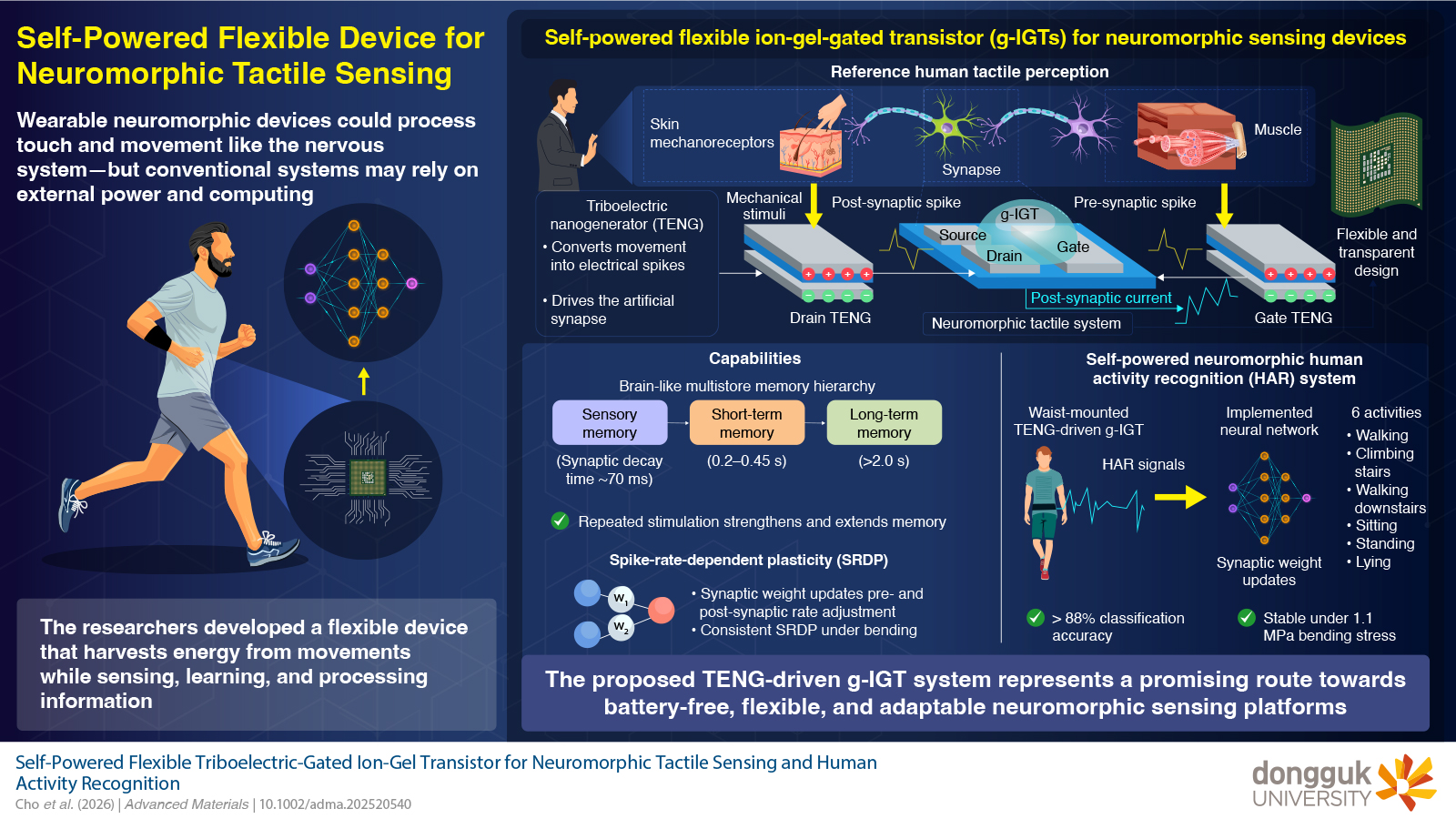
<Proposed self-powered, flexible neuromorphic sensing device>
Neuromorphic devices, which are designed to emulate aspects of biological neural networks, are promising candidates for developing low-power and intelligent sensing technologies, including wearable applications. Among the device architectures explored for neuromorphic computing, graphene-channel ion-gel-gated transistors (g-IGTs) are attractive because of their electronic properties, flexibility, and ability to modulate synaptic weights. Their low-voltage operation and ability to modulate synaptic weights make them attractive for mimicking the behavior of biological synapses. However, most current g-IGTs still rely on external power supplies, limiting practical use in wearable neuromorphic systems.
Addressing this challenge, a research team led by Professor Sejoon Lee from the Department of System Semiconductor at Dongguk University in South Korea has developed a battery-free, self-powered and flexible g-IGT device driven by a triboelectric nanogenerator (TENG). TENGs convert mechanical stimuli, such as body movement, touch, or vibration, into electrical signals. Their study was made available online on March 09, 2026, and published in Volume 38, Issue 37 of Advanced Materials on July 02, 2026.
Explaining their inspiration, Prof. Lee says, “In human tactile perception mechanoreceptors sense even minute mechanical disturbances and convert them into neural spikes. To replicate this process electronically, we integrated a triboelectric nanogenerator with a g-IGT that converts mechanical stimuli into electrical signals that directly regulate artificial synaptic behavior without requiring external power.”
In the human arm, mechanoreceptors convert skin deformation into electrical signals that are transmitted through neurons and processed at synapses. Mimicking this process, the proposed device employs two TENGs connected to a single g-IGT. The TENG connected to the g-IGT gate supplies pre-synaptic spikes, while the drain-side TENG provides post-synaptic spikes. When TENGs sense mechanical stimuli such as touch, they produce voltage pulses that drive the synaptic response of the g-IGT. This circuit operates entirely without an external power source, harvesting energy directly from mechanical stimuli.
Importantly, the researchers demonstrated that the device can exhibit hierarchical memory processes, similar to biological neural networks. Specifically, the device can exhibit sensory memory with a decay time of about 70 milliseconds and short-term memory (STM) with decay times of 0.2–0.45 seconds. In addition, repeated stimulation can transition short-term memory toward long-term memory, with a decay time exceeding 2 seconds.
The researchers also demonstrated spike-rate-dependent plasticity (SRDP), a fundamental learning and memory mechanism, enabling synaptic strength to change according to the frequency of incoming spikes. This SRDP functionality remained stable even under bending.
Furthermore, the researchers evaluated the device’s learning capability by implementing its experimentally measured synaptic behavior in a single-layer artificial neural network for human activity recognition. Using publicly available human-motion data, the system classified six human activities: walking, sitting, standing, lying, walking upstairs and walking downstairs, with 88.05% accuracy using TENG-driven synaptic behavior under bending. Under high-noise conditions, the system maintained more than 75% accuracy, although performance decreased under extreme signal distortion.
Potential applications of this technology include self-powered wearable health-monitoring devices, electronic skin, smart prosthetics, human–machine interfaces, and intelligent motion-monitoring systems.
Looking ahead, Prof. Lee says, “Our research could contribute to a new generation of wearable artificial intelligence systems that operate with minimal reliance on batteries or external computing resources. More broadly, our work points toward self-powered neuromorphic electronics with integrated sensing, memory, learning, and information processing in a single flexible platform.”

- Seoul Campus
- 30, Pildong-ro 1-gil, Jung-gu, Seoul, 04620, Republic of Korea
- Tel. +82-2-2260-3314 Fax. +82-2-2260-2277
- incoming@dongguk.eduExchange Program
- scf@dongguk.eduInternational Students Services
- adm@dongguk.eduInternational admission
- cscenter@dongguk.eduCertificate Issuance, Education Verification
- kic@dongguk.eduKorean Language Course
Copyright(c) DONGGUK UNIVERSITY. ALL RIGHTS RESERVED.